Red Art and Utopia in the Land of Soviets

From 20th March 2019 to 1st July 2019 the Chiliad Palais will pay homage to Soviet art with its exhibition, "RED : Art and utopia in the land of Soviets". Artsper takes y'all back in time to the heart of Soviet art, and so you can discover more nearly this turbulent period in history.
While the Soviet regime undoubtedly inverse the course of history it besides turned the art world upside downwardly, resulting in a distinctive art motion rich in radical ideologies. The regime's goal was to propose an alternative utopia to the world; one that had never been seen before. As a effect, a new art motility was born which offered valuable insight into this historical menstruum, and it continued throughout the authorities from its very beginning to its disgraced end. We can therefore draw parallels between the movement's evolution and the leaders of the Soviet bloc: Lenin, Stalin, Khrushchev and Gorbachev, were each symbolic during their reign in the USSR.
Art'south Contribution to Lenin's Revolutionary Utopia (1917- 1924)
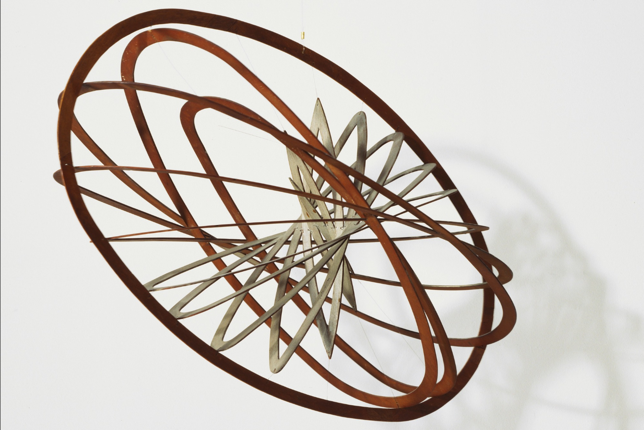
Although it was the Russian Empire that allowed the Russian avant-garde to advance, its popularity notwithstanding continued fifty-fifty after The October Revolution. The Bolshevik Revolution transformed art and artists: it rendered art accessible to the proletariats and continued fine art to the new life promised past the Revolution. Artists such as Rodchenko and Klutsis turned towards new forms of fine art, including graphic fine art, design and architecture in social club to oppose the "erstwhile social club". Artists were relatively unrestrained during the showtime years of the Soviet Union, all the same many others escaped the regime due to their opposition to the Bolshevik government. Although Lenin prefered more traditional art to newer movements such as Futurism or Expressionism, he remained supportive of the developing creative scene. He saw the popularity of the arts as an opportunity for making his policies accessible to the masses.
Socialist Realism: Stalin's Political Instrument (1924- 1953)
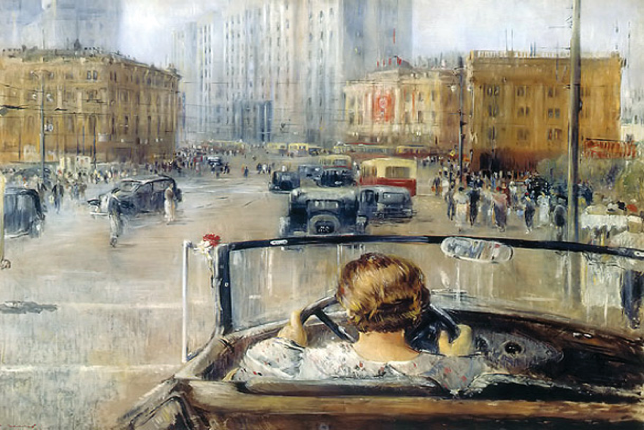
Official Art: The Orburo of the Central Committee of the Communist Party of the Soviet Matrimony was quick to restrict literary and artistic organisations. This permitted information technology to create instead, a sole wedlock of writers and artists that adhered to and disseminated the authorities's ideas.
This was the starting time of Socialist Realism, which was the merely official art move of the Soviet Matrimony. Its goal was to use realist styles that depicted the "social reality" of the working class, labourers and soldiers. At that place were severe repercussions for those that did non comply, so talented artists like Deïneka, Pimenov and Samokhvalov, took on lath this motion regardless of whether they supported the Socialist regime or non.
Dissident Fine art: Stalin's communism had no enemies, or rather it didn't tolerate them; those who were opposed to it were chop-chop removed. This drastic measure out as well applied to artists, where all art movements other than Socialist Realism were heavily controlled. All dissident creatives were censored, and non conforming to censorship was punishable past imprisonment in the terrible Gulag labour camps. Fine art students were even taken prisoner in Siberian camps, like Ülo Sooster, who later became an important fellow member of the Soviet Nonconformist Fine art movement in Moscow.
Soviet Nonconformist Fine art under Khrushchev and Brezhnev (1953-1985)

After Stalin's expiry and nether the new rule of Khrushchev, the USSR experienced a catamenia of "De-Stalinization". Every bit a consequence, artists felt more than liberated and less agape of the consequences of the their creations. Even though no official political change had occurred, artists regained the confidence to experiment with their art. However, artistic politics were far from being liberal. Although Khrushchev used art as his "showcase" of East Berlin, he also aggressively criticised sure avant-garde artists. During an exhibition at the Moscow Manege in 1962, he branded various abstract works, included those by Ernst Neizvestny, equally nonconformist "degenerate fine art". Despite this, the second wave of the Russian avant-garde was in the making, every bit artists grew increasingly defiant of USSR rules.
Rule Under Gorbachev: from Artistic Liberty to the Cease of the Movement (1985-1991)
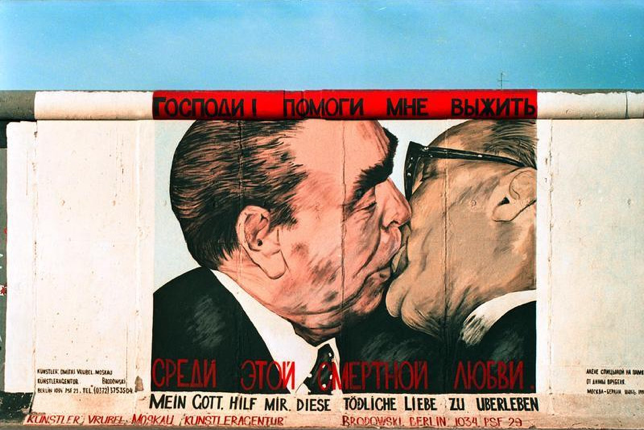
In 1985, Gorbachev's political policies "Perestroika" and "Glasnost" prevented the authorities from imposing restrictions on artists. With the collapse of the Soviet Wedlock in 1991, artists were no longer reliant on the Communist Land to create artworks. This freedom to create without fear was axiomatic in Russian street artist Dmitri Vrubel's works. In 1990 he completed his famous piece, My God, Help Me to Survive This Deadly Love also known equally The Fraternal Kiss, that decorates a department of the Berlin Wall. This deliberately provocative work was recreated from a photograph taken 10 years earlier, that captured Brezhnev and Gdr leader Erich Honeckerin in a fraternal embrace. Through this work, Vrubel portrays the diminishing control of the Soviet Spousal relationship and the liberation of art. Notwithstanding, every bit the USSR declined and then did nonconformist art, as its existence served to fight confronting this disgraced regime.
Source: https://blog.artsper.com/en/a-closer-look/art-in-the-land-of-soviets/
0 Response to "Red Art and Utopia in the Land of Soviets"
Post a Comment